The Beginner's Guide to the Smith Machine
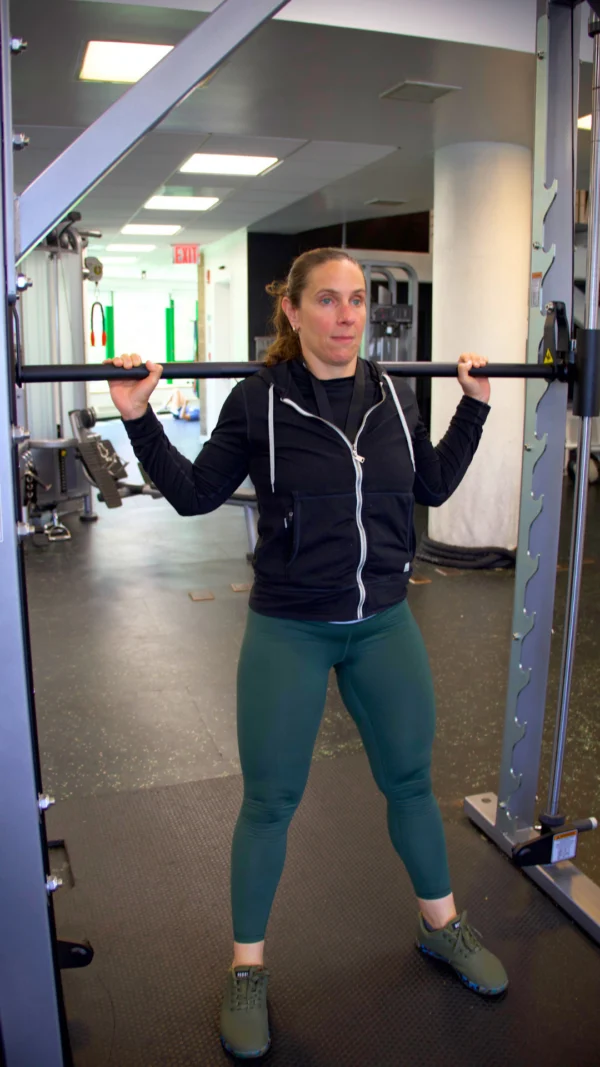
Walk into any gym and you’re likely to find a Smith machine — that tall, track-mounted barbell that seems to spark endless debate among gym-goers. Some swear by it; others dismiss it. The truth? For beginners or even those looking to progress on their journey, the Smith machine is a genuinely excellent tool.
Its built-in vertical track guides the bar through a fixed path, which means you can learn movement patterns with more stability and control before transitioning to free weights. There’s also a built-in safety mechanism: you can rack the bar at any point simply by rotating your wrists. No spotter required.
How to use the Smith Machine
Before you load a plate, get familiar with how the Smith machine works:
- The bar is fixed to a vertical rail system and moves straight up and down (or on a slight angled track, depending on the model).
- At Asphalt Green, the bar itself starts at thirty lbs — lighter than a standard free barbell. Factor this in when selecting your plates.
- Safety hooks: At any point, you can rotate your wrists to catch the bar on the J-hooks built into the rack. Practice this before adding weight.
- Height adjustment: Set your starting position by rotating the bar off the hook at the height that matches the exercise you’re doing.
Pro Tip: Before your first working set, practice rotating the bar into the safety hooks under no load. This reflex can save you if a set gets away from you.
Three Essential Smith Machine Exercises
1. Smith Machine Squat
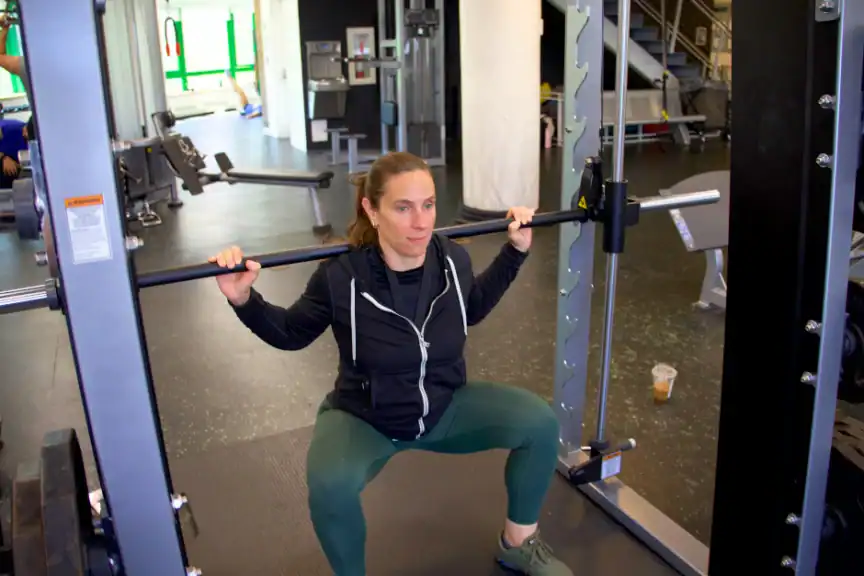
The Smith machine squat is a superb teaching tool for squat mechanics. The guided bar path lets you focus entirely on leg drive, depth, and posture.
Unlike a free barbell squat where the bar sits over your mid-foot, in the Smith machine you want to position your feet slightly forward of where they’d be for a free squat — about 6–12 inches in front of the bar’s vertical path. This compensates for the fixed bar path and puts the load more effectively through your hips and legs.
How to perform the Smith Machine Squat
- Set the bar at upper-chest height. Step under the bar, resting it on your upper traps. Grip just outside shoulder-width.
- Walk your feet forward until they’re slightly in front of you. Feet shoulder-width apart, toes out 15–30 degrees.
- Rotate the bar to unrack. Take a breath, brace your core.
- Descend by pushing your knees out and sitting back into your hips. Lower until thighs are parallel.
- Drive through your feet to stand, exhaling on the way up. Rotate to rerack when done.
2. Smith Machine Bench Press
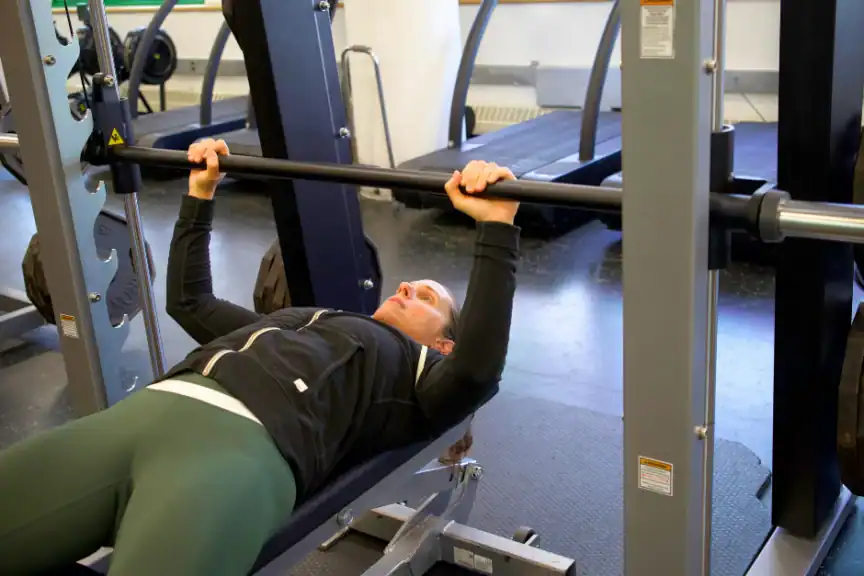
The Smith machine bench press is particularly useful for those who don’t yet have a consistent spotter. The bar can be racked safely at any moment, letting you train at a challenging intensity with confidence.
How to perform it:
- Place a flat bench directly under the bar. Lie back so the bar aligns with your lower chest.
- Grip slightly wider than shoulder-width. Plant your feet on the floor and squeeze your shoulder blades together.
- Rotate the bar off the hooks. Lower it to your lower chest in a controlled arc.
- Press the bar back up in a straight line, exhaling as you push. Keep your glutes, upper back, and feet in contact with their surfaces.
- Rotate to re-rack once your set is complete.
3.Smith Machine Romanian Deadlift (RDL)
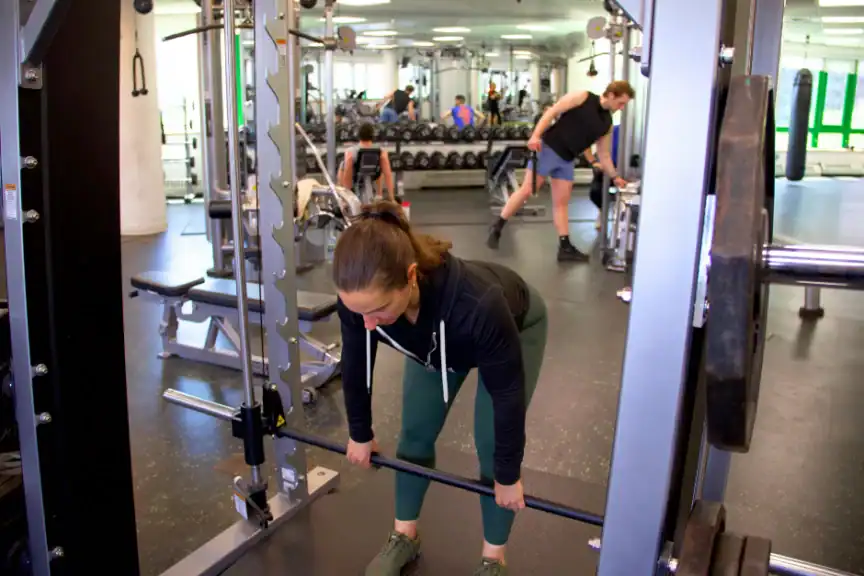
The Romanian Deadlift targets the hamstrings, glutes, and lower back through a hip-hinge movement. The Smith machine’s fixed path makes it an ideal version for beginners to learn the hinge pattern safely.
How to perform the Smith machine Romanian Deadlift:
- Set the bar at hip height. Stand close to the bar with feet hip-width apart and grip the bar just outside your hips.
- Rotate the bar off the hook. Stand tall with soft knees, shoulders back.
- Hinge at your hips — push them back like you’re trying to touch a wall behind you — while lowering the bar down your thighs. Keep your back neutral and flat throughout.
- Lower until you feel a strong stretch in your hamstrings (typically when the bar reaches mid-shin to ankle level, depending on your flexibility).
- Drive your hips forward to return to the starting position. Squeeze your glutes at the top.
When should you use the Smith Machine vs Free Barbell?
As you build up your strength and become more comfortable in the gym, there’s a place for both the Smith machine and barbell in your routine.
- Use the Smith machine to learn movement patterns, train to higher intensities without a spotter, or isolate a muscle when recovering from minor fatigue or imbalance.
- Gradually incorporate free barbell work as your strength and coordination develop. Free weights engage more stabilizing muscles and translate more directly to functional strength.
- The Smith machine is not a crutch — it’s a stepping stone. Many experienced lifters continue to use it as a valuable training tool.
Try A Smith Machine Workout With Asphalt Green Fitness
No matter what goals bring you to the Smith machine, Asphalt Green Fitness is here to help you make the most of it. Book a session today to try a Smith machine workout under the guidance of an a certified AG Fitness trainer who can ensure proper form and build a full routine based on your goals.